How to Frame and Display a Tintype
Of all the questions I get after a session, framing is the one that comes back the most. People get the plate home, hold it up against the wall, and then email me: now what?
Here's everything I tell them, including exactly how I frame my own plates. Fair warning up front: my way isn't the only way. But there's one rule that isn't optional, so let's start there.
The one rule: the plate can never touch the glass
If a tintype sits directly against glass, the emulsion can slowly adhere to it over time, and there's no good way to undo that. Every framing method that works, works because it keeps a small air gap between the plate and the glass. Everything below is really just a different way of creating that gap.
If you remember nothing else from this post, remember the gap.
How I frame mine
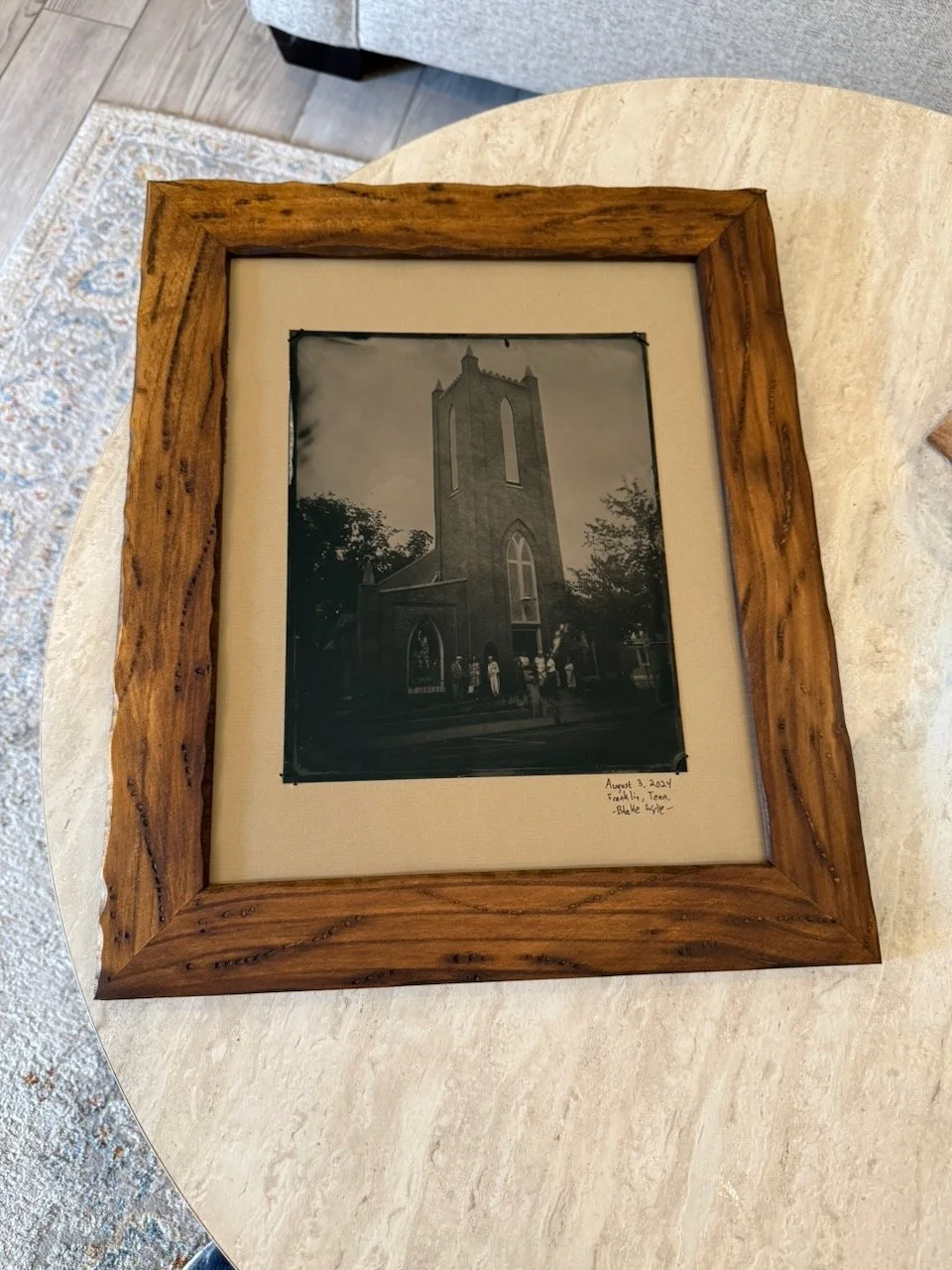
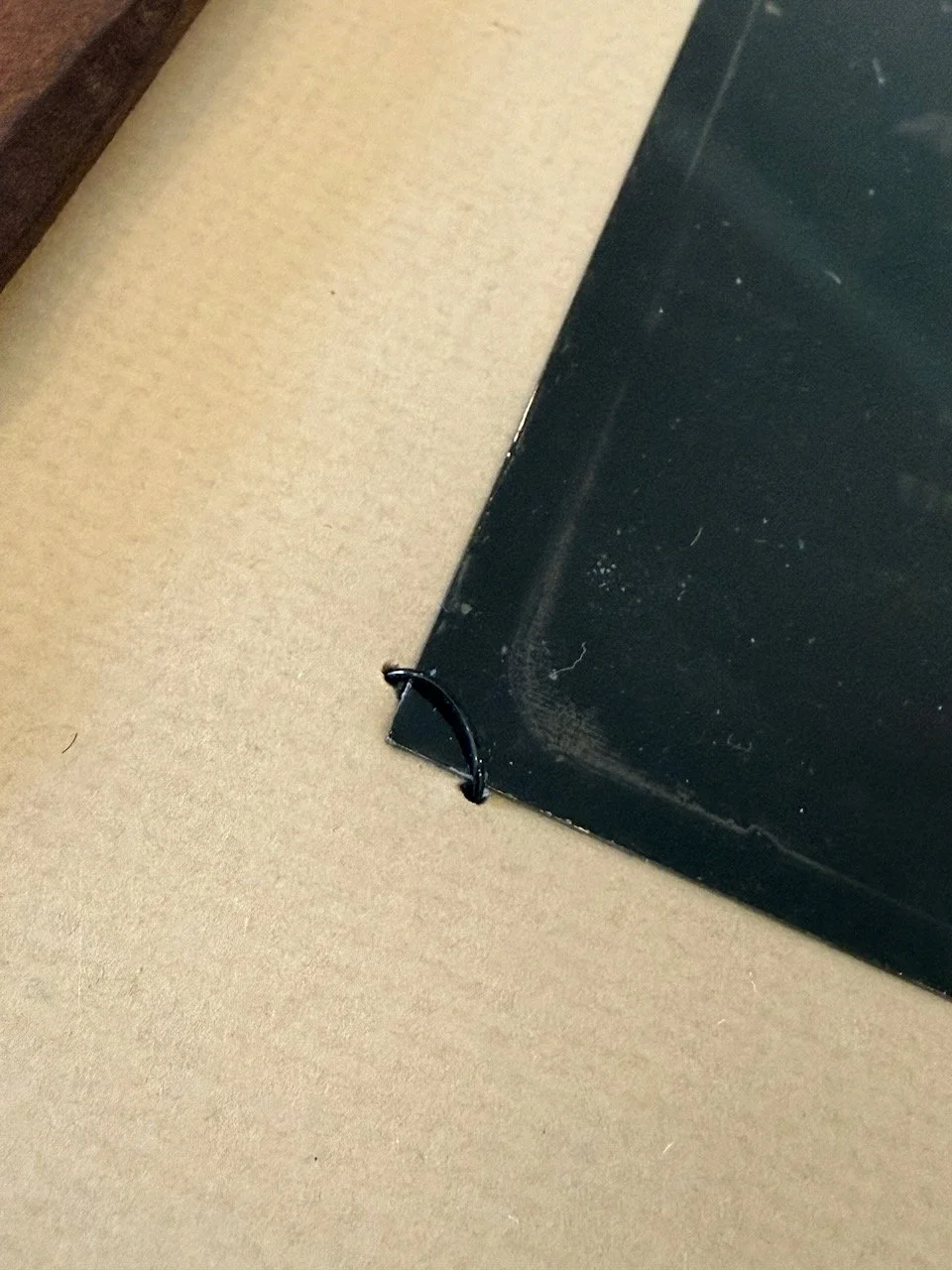
My preferred method shows the entire image, edge to edge, with nothing overlapping the plate. It uses metal thread to hold the plate slightly off the mat board, which creates the air gap naturally.
Cut a mat board to fit your frame, and decide where the plate sits on it.
At each corner of the plate's position, poke two small holes through the mat board, one on either side of the corner.
Get some metal thread. Craft stores carry it in the jewelry making section; Hobby Lobby and Michaels both have it.
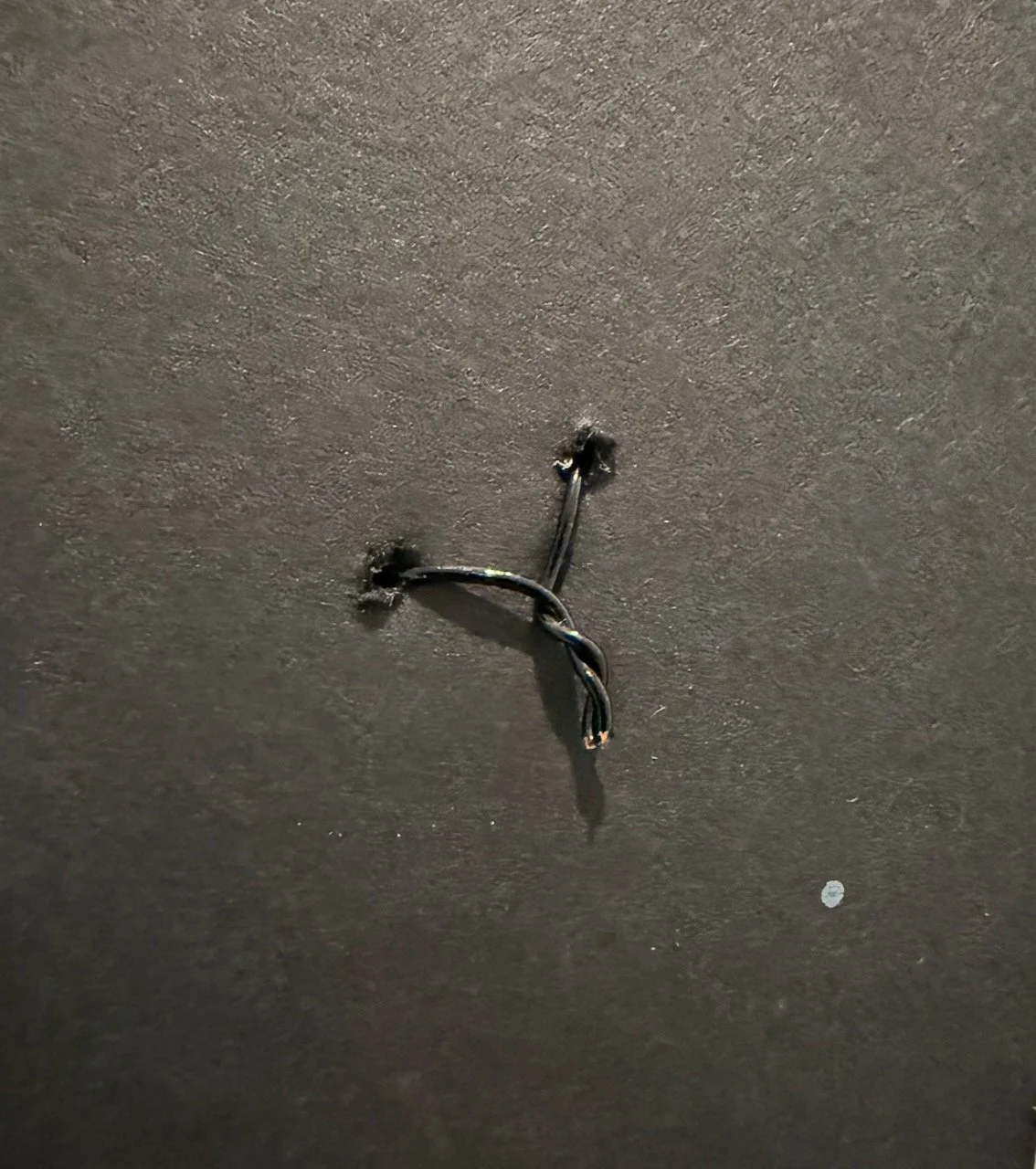
Run a length of thread over each corner of the plate and push both ends through the holes. Pull it snug, cut it, and twist the ends together on the back of the mat.
Fold the twisted ends down flat against the back. Careful here: those cut threads are sharp, and they will find your fingertip eventually. I speak from experience.
Put a backboard behind the mat inside the frame. It covers the sharp ends and keeps everything tidy.
The thread holds the plate just proud of the mat, so the plate never touches the glass, and you see the whole image, right out to the edges where the hand-poured chemistry does its most interesting work.
The frame in the photos below has Museum Glass in it, and it's the reason the plate reads so clearly. From most angles you can't tell there's glass there at all. That matters more with a tintype than with a paper print, because the image is silver and reflective on its own. Ordinary glass adds a second layer of glare on top of that, and Museum Glass takes it away, so the silver does the shining instead of the glass. It also filters UV, which protects the plate over the decades. It costs noticeably more than regular glass, but on a piece you plan to keep for a lifetime, it's worth every penny.
The standard mat option
A regular window mat works too, and it's simpler. The mat's thickness creates the air gap on its own. The tradeoff is that the mat window overlaps the edges of the plate slightly, so you lose a little of the image at the borders.
If you go this route, attach the plate to the backing with acid-free tape or acid-free photo corners. Tape is fine as long as it's acid-free and only ever touches the back of the plate, never the front. I wouldn't use glue. Whatever holds the plate should be reversible, like anything archival.
A note on shadow boxes
Shadow boxes feel like a natural fit for an object like this, but they don't do tintypes any favors. The image is silver, and it lives on the light that reaches it. Set the plate deep in a shadow box and it sits in exactly that: shadow. The image goes dull and dark right when it should be catching the room. You want the plate up near the glass, with its little air gap, where the light can find it.
Taking it to a professional framer
A good framer will do a beautiful job, and I recommend it for larger plates. But most framers rarely see a tintype, so you need to tell them three things:
The plate can never touch the glass. There must be an air gap. (Framers call this a spacer, and they'll know exactly what to do once you say it.)
Acid-free materials only. Tape on the back of the plate is fine; nothing touches the front, and no glue. Anything attached to the plate should be reversible.
Ask for Museum Glass. For everything it does for a tintype, see above. Any good framer will have it on hand, and this is the piece to spend the upgrade on.
You don't have to frame it at all
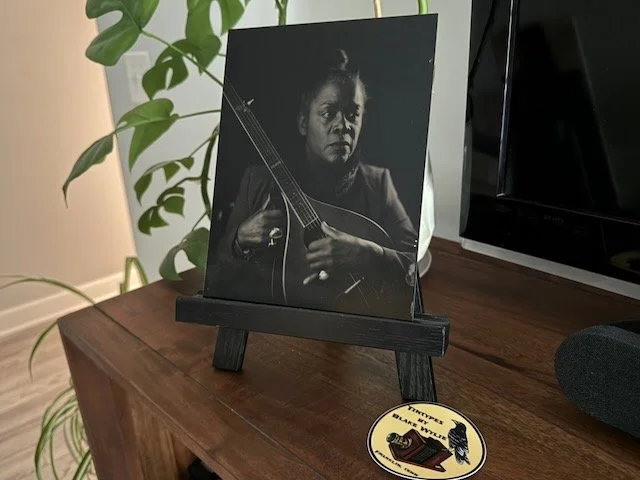
A tintype is a piece of metal. It doesn't need protecting from daily life the way a paper print does. Plenty of my clients keep plates on a shelf or a mantel using a small easel or a nice plate holder, and they look right at home that way. The image is silver, and it comes alive near a lamp or a window with indirect light.
The only real rule for open display: keep it out of long stretches of direct sunlight, and give it a light dusting now and then with a dry microfiber cloth. Barely any pressure. Dust is slightly abrasive, so grinding it across the plate will leave fine scratches in the varnish. Let the cloth do the work. No cleaners, ever. That's the whole maintenance routine. Tintypes will outlast all of us if you treat them gently, and I've written about how long tintypes last.
However you display it
Shelf, easel, my thread method, a framer's spacer: they all work, as long as the gap exists and the sun stays off it. These plates were built to outlast their owners. The framing just decides how good the image looks while it does.
And if you don't have a plate to frame yet, sessions are here.
About Blake Wylie
Blake Wylie is a contemporary tintype photographer and wet plate collodion artist. He has been creating tintypes and ambrotypes with the wet plate collodion process since 2011. Based in Franklin, Tennessee, near Nashville, his work spans handmade portraiture, fine-art projects, musician collaborations, and commercial commissions on metal and glass. He writes about tintype and early photographic processes from firsthand studio and on-location experience. His work has been featured by PBS Tennessee Crossroads, PetaPixel, Fstoppers, and other outlets.