Tintype, Daguerreotype, or Ambrotype? How to tell them apart
At least once a week, I scroll past a listing on Facebook Marketplace where someone is selling what they call a daguerreotype. And almost every time, it's a tintype.
I don't blame them. Unless you've spent time handling these objects, it's hard to know the difference. They're all old photographs on hard surfaces, they all have that sepia-toned feeling of another era, and most people have never heard the word "ambrotype" at all. But these three processes are actually very different from each other: different materials, different chemistry, different time periods, and very different results.
I work with two of the three regularly. I shoot tintypes and ambrotypes out of my studio in Franklin, Tennessee, and I collect historical daguerreotypes. I've made one daguerreotype myself, and honestly, holding that finished plate was one of the more moving experiences I've had as a photographer. There's a purity to the daguerreotype that's hard to describe until you've seen one in person.
So here's the breakdown: what each process is, how they were made, what they look like, and how to tell which one you're actually holding.
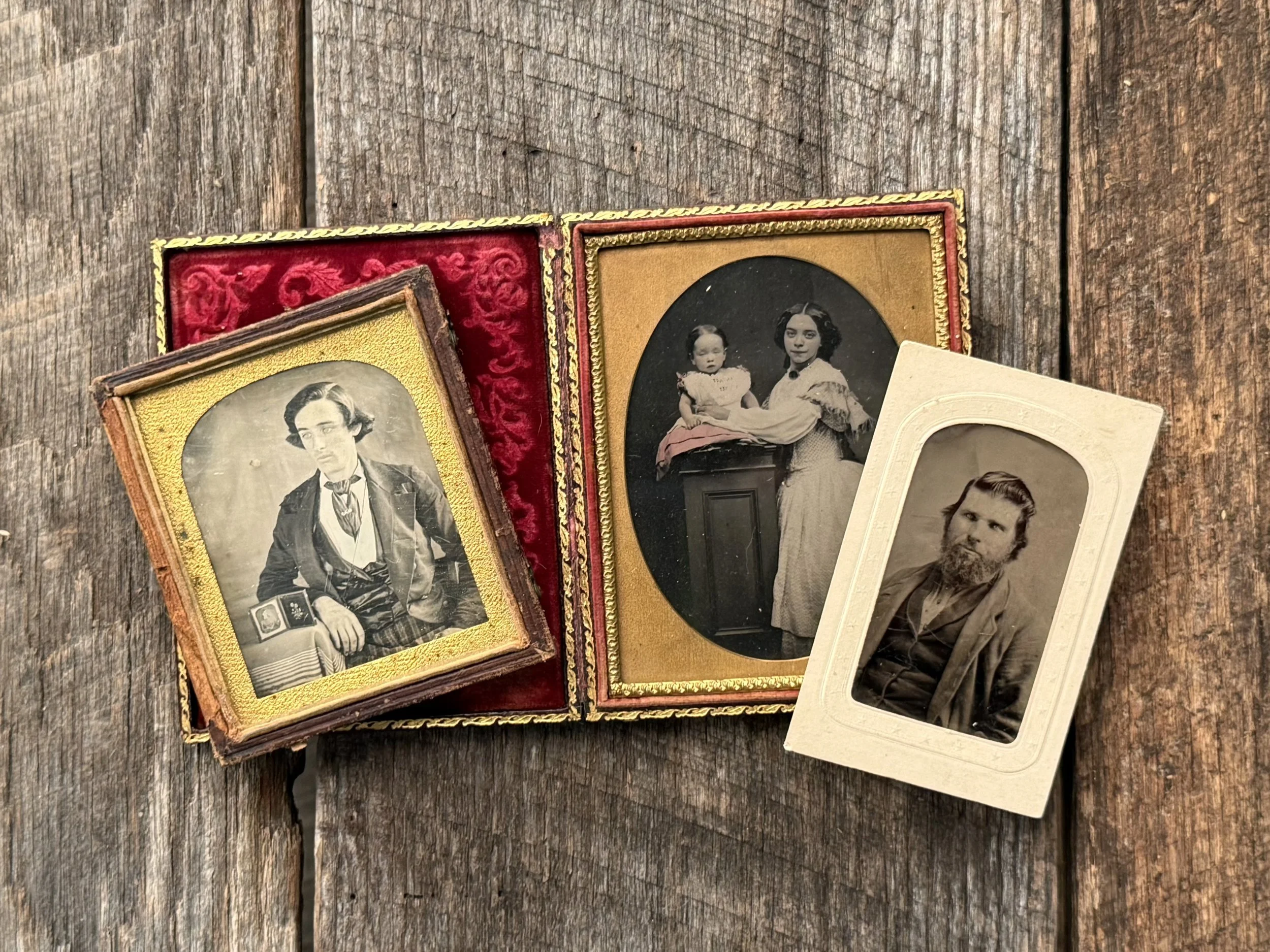
Left to right: a daguerreotype, an ambrotype, and a tintype. Three different processes, three different materials, three very different results.
The Daguerreotype (1839)
The daguerreotype is where photography begins. Louis-Jacques-Mandé Daguerre announced the process in 1839, and within months people across Europe and America were sitting for portraits. I'd call it one of the purest forms of photography ever created.
Here's how it works: a sheet of silver-plated copper is polished to a mirror finish, then exposed to iodine and bromine fumes, which make the surface light-sensitive. The plate goes into a camera, gets exposed (early daguerreotypes needed minutes of stillness, though by the 1850s exposure times had dropped considerably), and then the image is developed over heated mercury vapor. The result is fixed with sodium thiosulfate and rinsed.
What you end up with is an image made of mercury-silver amalgam sitting on a mirror-like surface. And that mirror quality is what makes daguerreotypes so distinctive and so difficult to photograph or reproduce. You have to hold one in your hand and tilt it to see the image properly. At one angle, it looks like a positive. Tilt it another way and it flips to a negative, or catches the light and becomes a mirror reflecting your own face back at you. There's nothing else in photography quite like it.
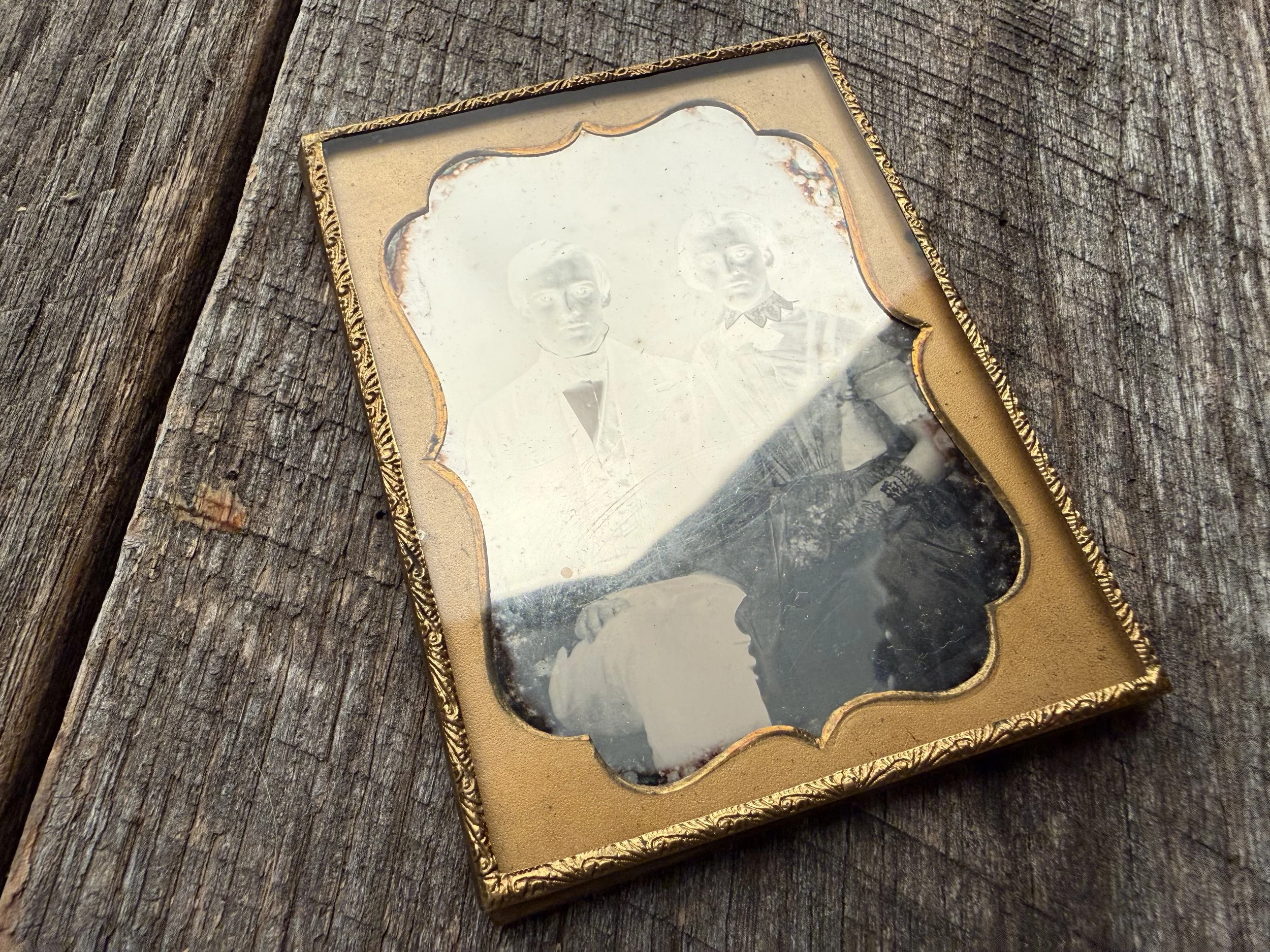
Tilt a daguerreotype and the image shifts from positive to negative to mirror. Nothing else in photography does this.
Daguerreotypes were typically housed in small hinged cases (leather, thermoplastic, or wood covered in paper) with a brass mat framing the image and a piece of glass protecting the surface. The whole package was sealed at the edges to keep air out, because the silver surface tarnishes when exposed to the atmosphere. That seal was the daguerreotype's lifeline.
Here's a problem I see with daguerreotypes that come up for sale: at some point over the last 170 years, somebody opened the case. Maybe they were curious. Maybe they thought the glass was dirty and tried to clean it. Whatever the reason, once that seal is broken and the plate is exposed to air, tarnish starts creeping in. Worse, people who've tried to clean the plate itself have often left white marks or scratches on the surface because the mercury-silver amalgam is incredibly sensitive. You cannot wipe a daguerreotype the way you'd clean a piece of glass. If you have a daguerreotype that needs resealing, the standard archival approach is to reassemble the sandwich (plate, mat, clean cover glass) and seal the edges with Filmoplast P90, an acid-free archival tape made for exactly this purpose. The Library of Congress has a detailed guide to daguerreotype preservation that's worth reading if you're handling one of these plates.
If you open an old case and see that mirror-like quality, that shifting image, you're almost certainly looking at a daguerreotype.
I'll say something that might sound strange coming from a photographer who shoots tintypes for a living: I think the daguerreotype is the superior photographic medium. The detail is unmatched. The tonal range is extraordinary. There's a reason the best surviving daguerreotypes still look better than most photographs made in the decades that followed. The process was just that good.
But the daguerreotype had real problems. It was expensive. It required serious skill and toxic chemistry (mercury vapor is no joke). And each plate was one-of-a-kind with no way to make copies. By the early 1850s, photographers were looking for something cheaper and faster. They found it.
The process was dominant from about 1839 to the mid-1850s, when a new invention called the wet plate collodion process started pulling photographers away from it.
How to identify a daguerreotype
It's on a polished, mirror-like metal surface (silver-plated copper)
The image shifts from positive to negative depending on viewing angle
It's almost always housed in a protective case with a brass mat and cover glass
It's heavy for its size. That copper plate has real weight to it
A magnet will not stick to it (copper, not iron)
The wet plate collodion process (1851) and everything it made possible
Before I get to ambrotypes and tintypes, I need to talk about the invention that connects them. In 1851, an English sculptor and photographer named Frederick Scott Archer published the wet plate collodion process. It changed everything.
The idea: coat a glass plate with collodion (a syrupy mixture of gun cotton dissolved in ether and alcohol), dip it in silver nitrate to make it light-sensitive, expose it in the camera while the plate is still wet, then develop and fix it. The result was a photographic negative on glass. Compared to the daguerreotype, the collodion process was faster, cheaper, and produced negatives you could actually print from. Photographers adopted it quickly.
The wet plate collodion process is the parent of both the ambrotype and the tintype. Same chemistry, same workflow, same developer, same fixer. The difference between the two is just what you pour the collodion onto. That one variable changes the look, the feel, and the durability of the finished piece. I'll get into those differences below.
And those two weren't the only offspring. Photographers experimented with pouring collodion onto all kinds of surfaces. There were pannotypes on leather and oilcloth. Ivorytypes that mimicked hand-painted ivory miniatures. People tried linen, ceramics, and other materials I'm probably forgetting. Archer's process was that adaptable. I'm focusing on ambrotypes and tintypes here because they're the ones you're most likely to encounter, and the ones people most often confuse with daguerreotypes. But it's worth knowing that the wet plate collodion family tree has more branches than most people realize.
The Ambrotype (1854)
The ambrotype came along about fifteen years after the daguerreotype, and it solved the daguerreotype's biggest practical problems: cost and difficulty. It was the first major application of Archer's collodion process for portraiture, and by the mid-1850s ambrotypes were rapidly replacing daguerreotypes in portrait studios.
An ambrotype is a photograph on glass. The process is exactly what I described above: collodion, silver nitrate, wet plate exposure, develop, fix. The result is actually a negative image on glass. It only looks like a positive because dark material is placed behind it.
One thing most people don't realize: the glass itself matters. Most ambrotypes you'll encounter were made on ruby glass, a dark reddish glass that naturally provides the dark backing the image needs to read as a positive. The ruby glass does double duty. Clear glass ambrotypes do exist, but they're less common. You'll sometimes see them in earlier examples from the 1850s, and clear glass plates were also used for contact printing, where the negative was pressed directly against photographic paper to make a print. But if you're holding an ambrotype, odds are good it's on ruby glass.
Here's an interesting bit of history: as photographers transitioned from daguerreotypes to ambrotypes in the 1850s, many of them advertised the new process as superior to the daguerreotype. You can find period advertisements where studios boasted about ambrotypes being a better, more lifelike likeness. I understand why they did it. They needed to convince paying customers to try something new. But having worked with both processes, I respectfully disagree. The daguerreotype produces an image with a depth and precision that the ambrotype doesn't quite match. The ambrotype has its own beauty, but it's a different kind.
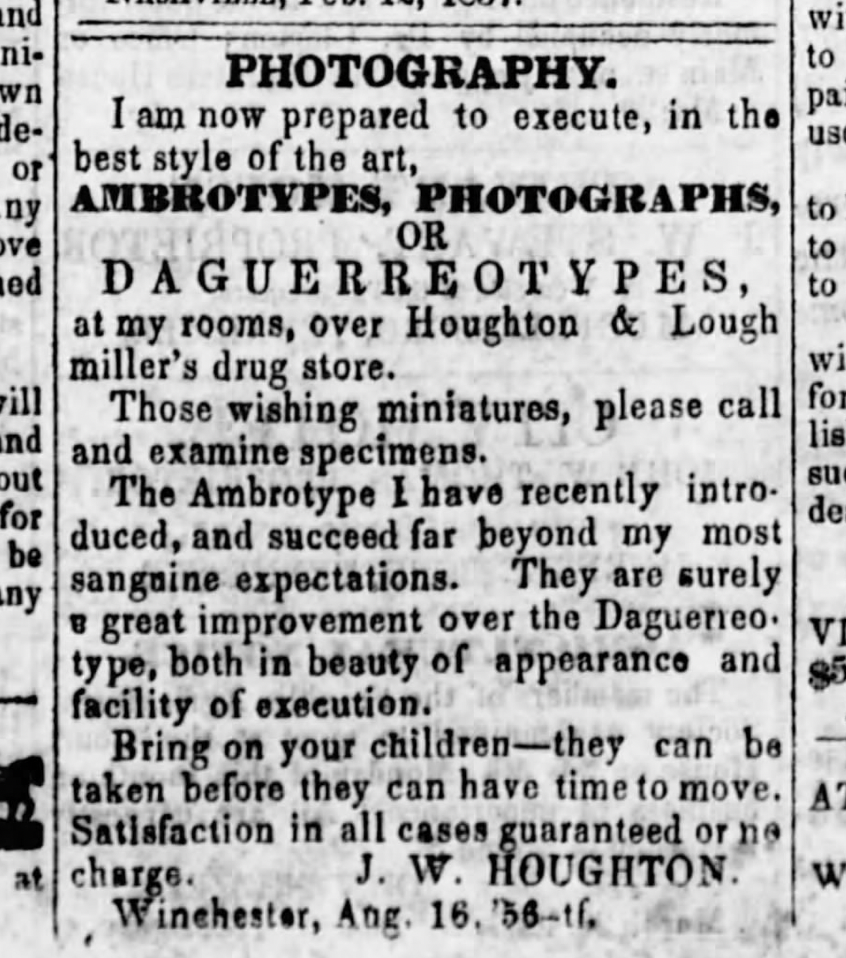
In this 1857 advertisement, Winchester, Tennessee photographer J.W. Houghton promotes the ambrotype as a great improvement over the daguerreotype. Courtesy of the Tennessee State Library & Archives.
I shoot ambrotypes alongside my tintype work because the process is nearly identical. The chemistry is the same. The camera is the same. The darkroom workflow is the same. The only real difference is what you pour the collodion onto. Glass instead of metal. But that single difference changes the look of the finished piece quite a bit. Ambrotypes have a softness and depth to them because you're seeing the image through glass, with that dark backing creating the contrast. There's a luminous quality that's different from the surface-level punch of a tintype.
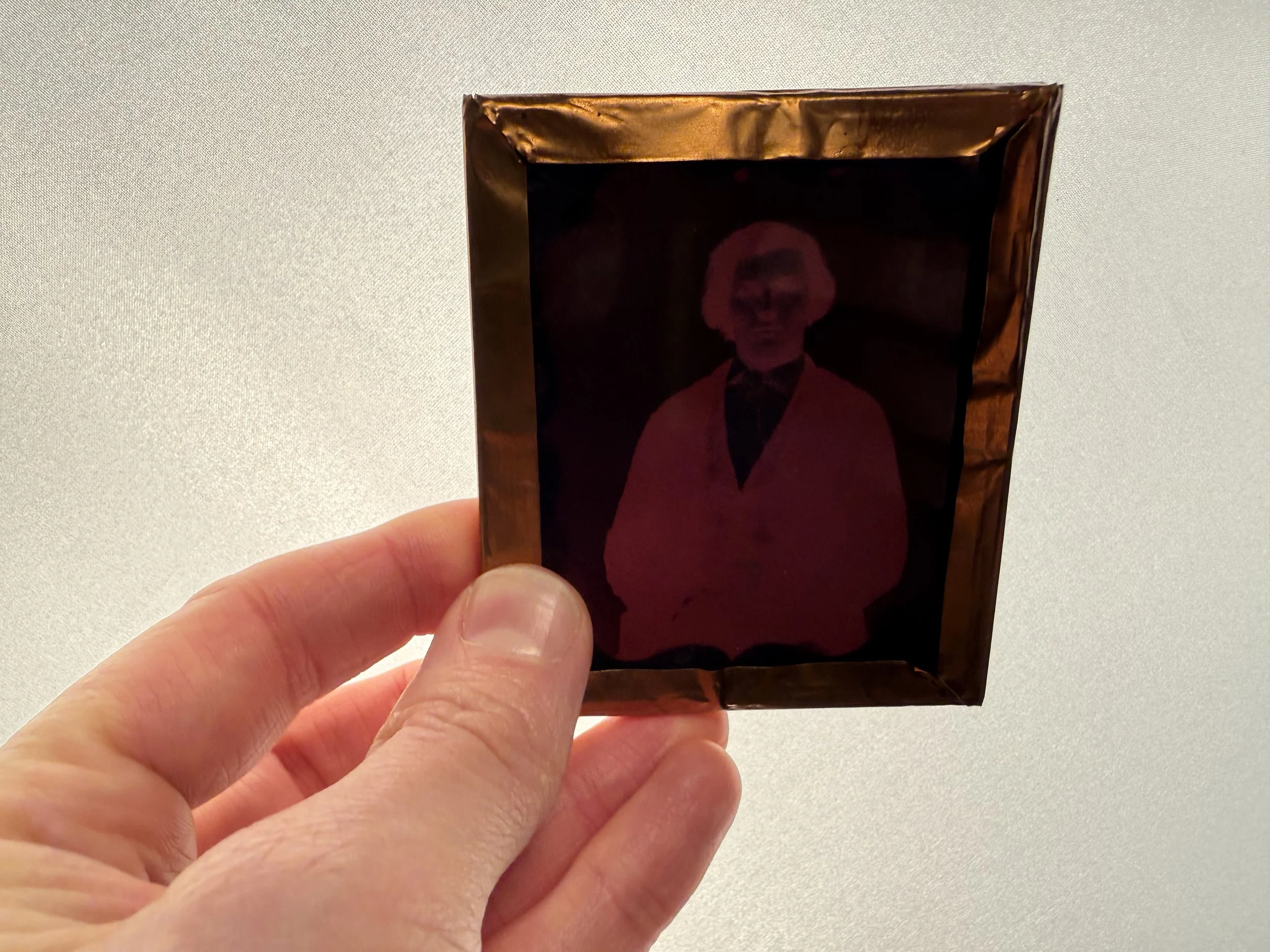
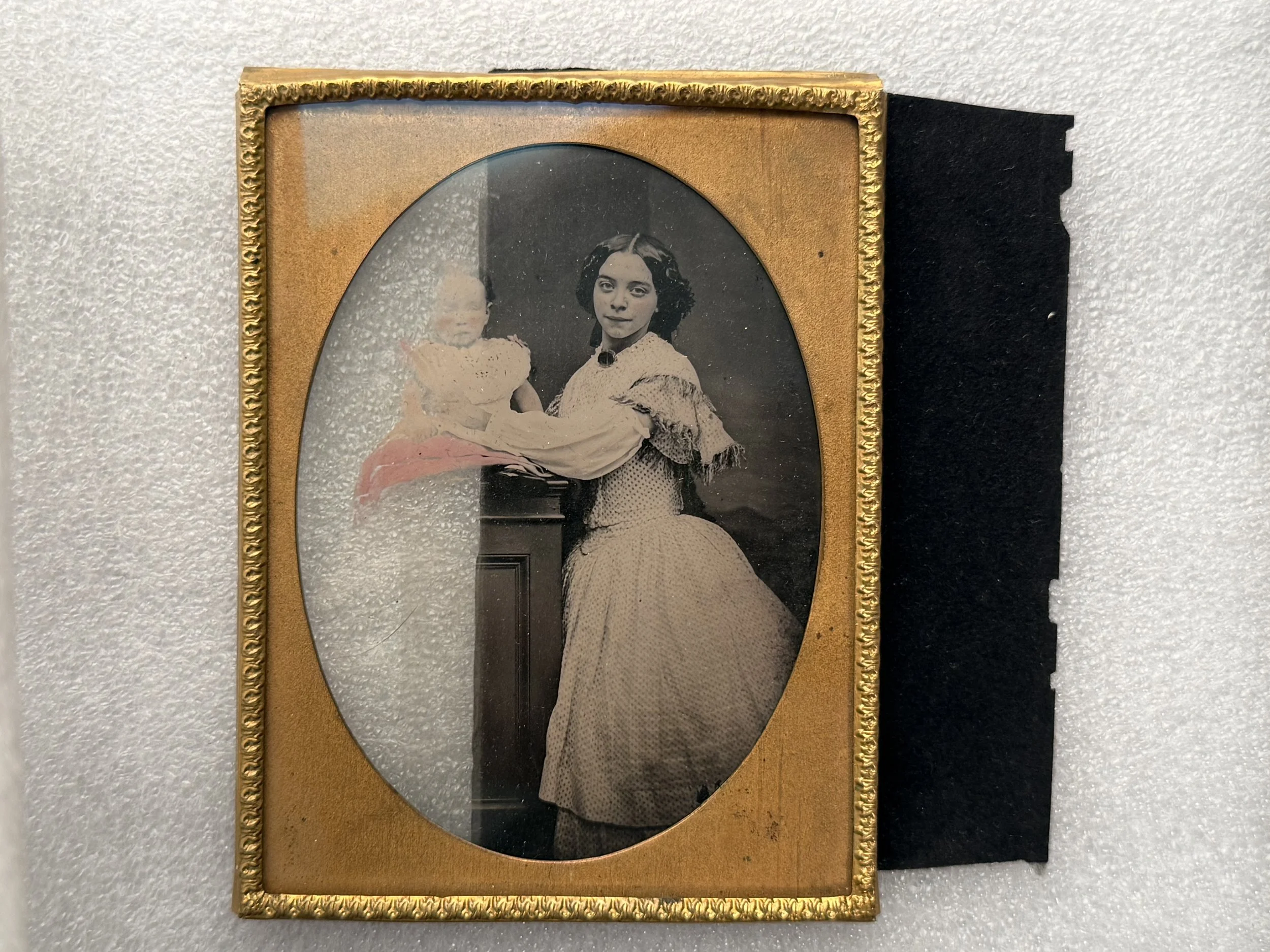
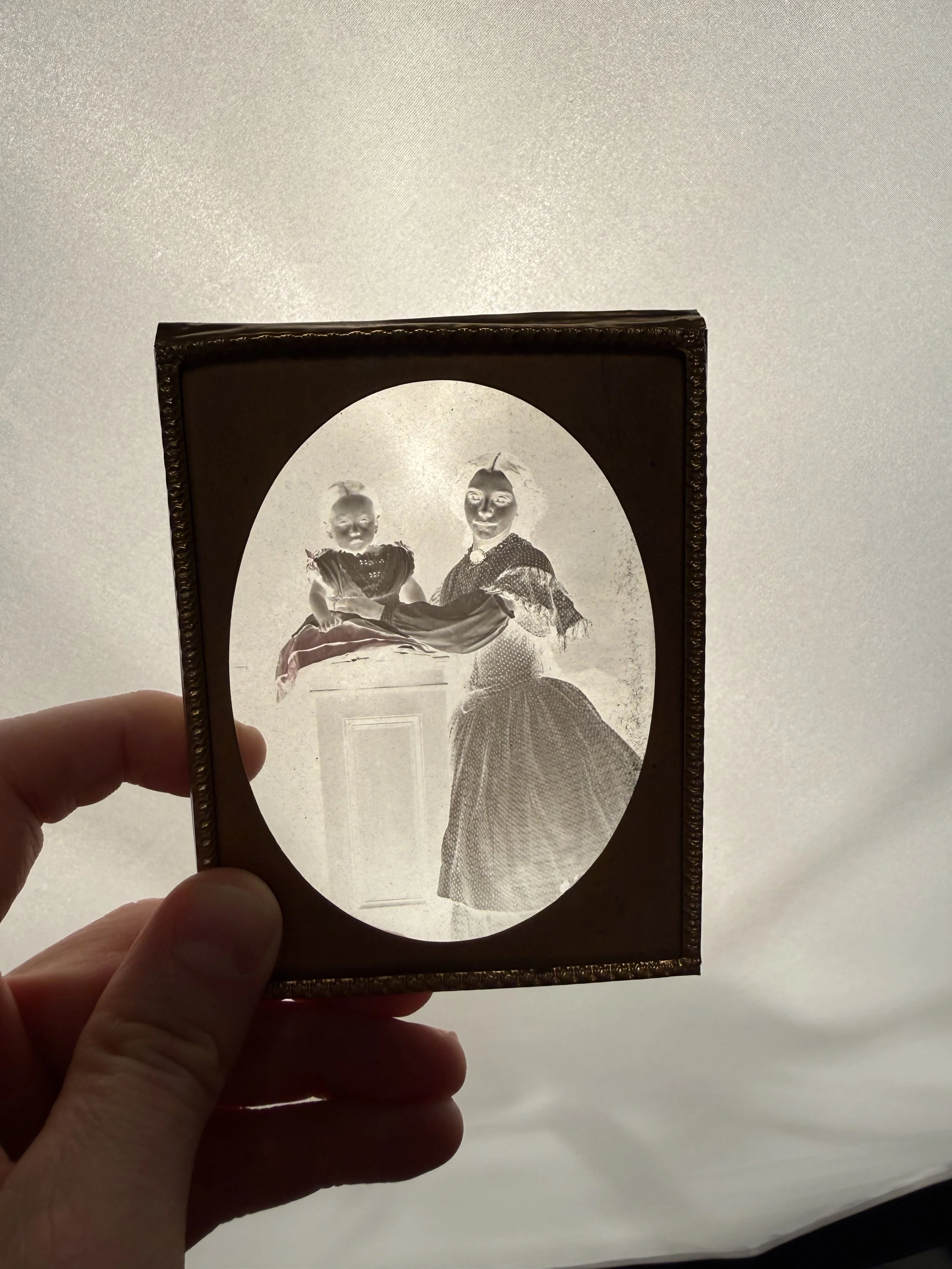
Like daguerreotypes, ambrotypes were typically housed in small cases with brass mats. This is one reason people confuse them with daguerreotypes. Same case, same general size, same era. But the look of the image itself is quite different once you know what to watch for.
Ambrotypes were popular from about 1854 through the early 1860s, when tintypes and carte de visite photographs on paper largely took over.
How to identify an ambrotype
It's on glass, usually ruby (dark reddish) glass and sometimes on clear glass. You can sometimes see the edges of the glass plate
The image does not have the mirror-like, shifting quality of a daguerreotype
If you remove the backing material, the image appears as a negative
Often housed in a case similar to daguerreotypes
It's lighter than a daguerreotype but still has the weight of glass
Can be fragile. The glass can crack, and sometimes the collodion separates from the glass over time
The Tintype (1856)
Here's where my daily work lives. In 1856, Hamilton L. Smith, a professor of chemistry and physics at Kenyon College in Ohio, patented the idea of using Archer's wet plate collodion process on metal instead of glass. (Adolphe-Alexandre Martin had described a similar idea in France a few years earlier, but Smith's patent is what brought the process to the United States.) The result was the tintype, also called a ferrotype, and it quickly became the most popular and accessible photographic process of the 19th century.
A tintype is made using the same wet plate collodion chemistry as an ambrotype. Same collodion, same silver nitrate sensitizing bath, same developer, same fixer. The difference is the base: instead of glass, the collodion is poured onto a thin sheet of metal.
And here's the thing that surprises most people: there is no tin in a tintype. Historic tintypes were made on thin sheets of iron that had been japanned (coated with a dark lacquer). The name "tintype" probably comes from the fact that they were cheap, and "tin" was slang for something inexpensive. The more technically accurate name is ferrotype - "ferro" for iron. But "tintype" stuck, and that's what everyone calls them. No reason to fight it.
Today, most of us working in the process use black aluminum instead of iron. Aluminum doesn't rust, it's lighter, and it takes the collodion beautifully. The look is the same. The process is the same. The material is just better suited to lasting.
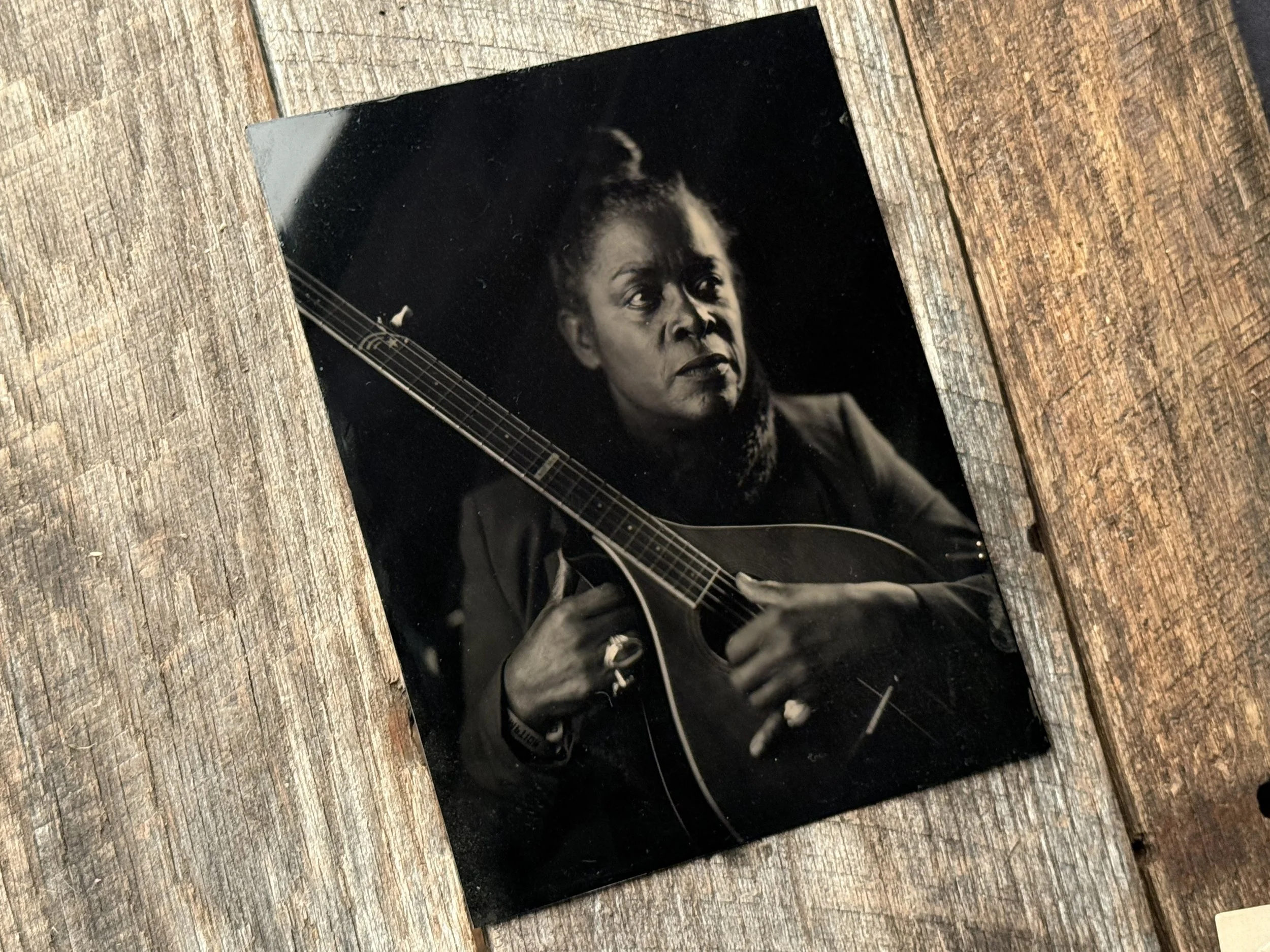
A modern tintype shot in my Franklin, Tennessee studio. Same wet plate collodion chemistry photographers used in the 1860s.
What makes tintypes distinct from ambrotypes is that the image sits on an opaque metal surface rather than on glass backed by something dark. The metal itself provides the dark background. This gives tintypes a more direct, almost confrontational quality. The image is right there on the surface, looking back at you. No glass between you and the photograph.
Tintypes were also far more durable than ambrotypes. Glass breaks. Iron (and aluminum) bends but doesn't shatter. This durability is part of why so many tintypes have survived, and why tintypes can last well over a hundred years when stored properly. Civil War soldiers carried them in their pockets. Families tucked them in drawers and albums. Unlike daguerreotypes and ambrotypes, they didn't need a protective case to survive.
And that Civil War connection is worth pausing on, because the tintype's rise and the war happened at almost exactly the same time. The timing matters. Suddenly you had hundreds of thousands of soldiers moving across the country, far from home, with no way to see the faces of the people they'd left behind. The tintype was cheap enough that an ordinary soldier could afford one. Traveling photographers set up portable darkrooms near camps and battlefields. A soldier could sit for a portrait, get the finished plate in minutes, and mail it home. Families could send portraits back. For the first time, photography belonged to regular people. I think of the tintype as the real democratization of photography. The daguerreotype had been a luxury. The ambrotype brought the cost down. But the tintype made it available to almost everyone.
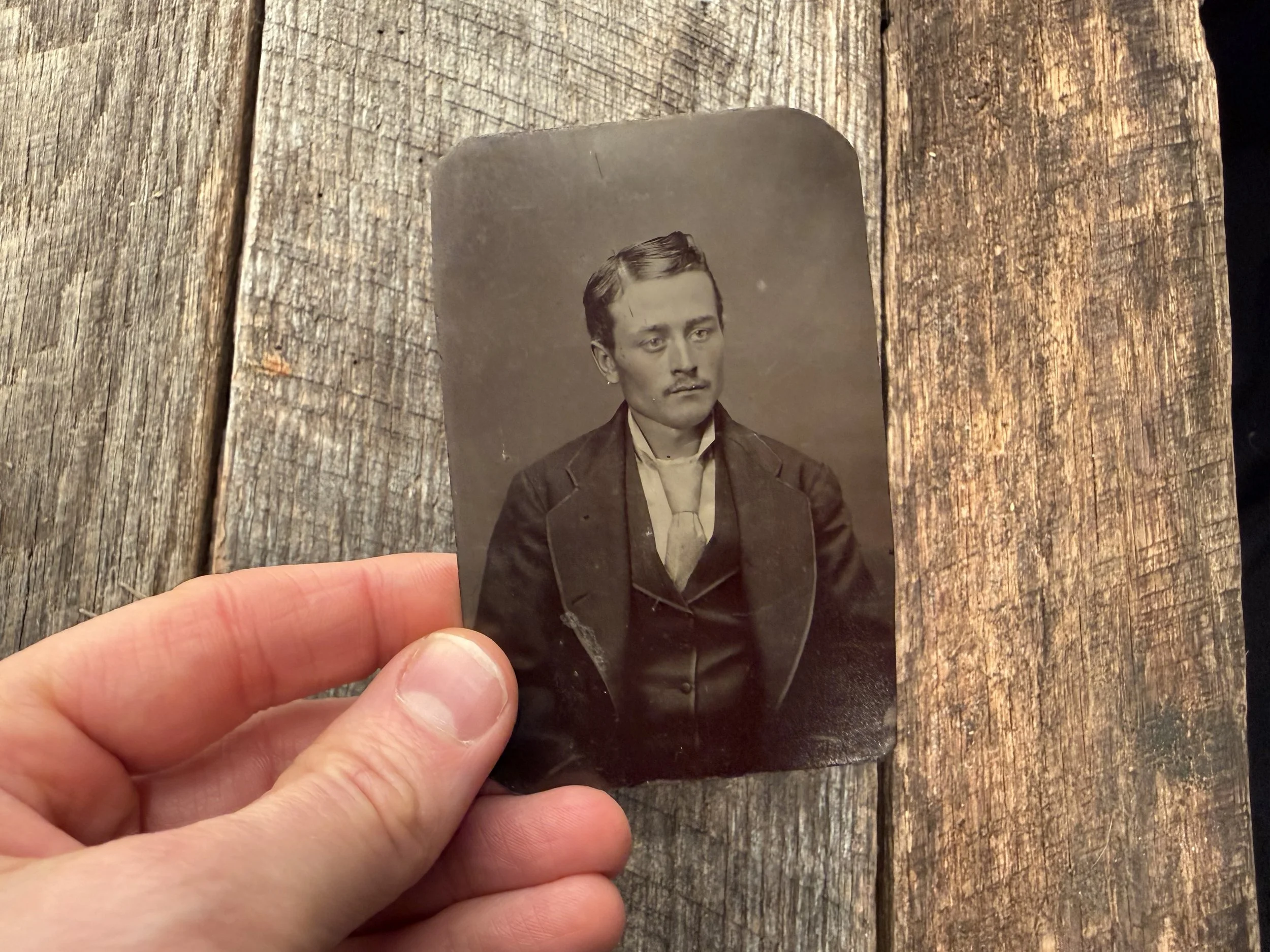
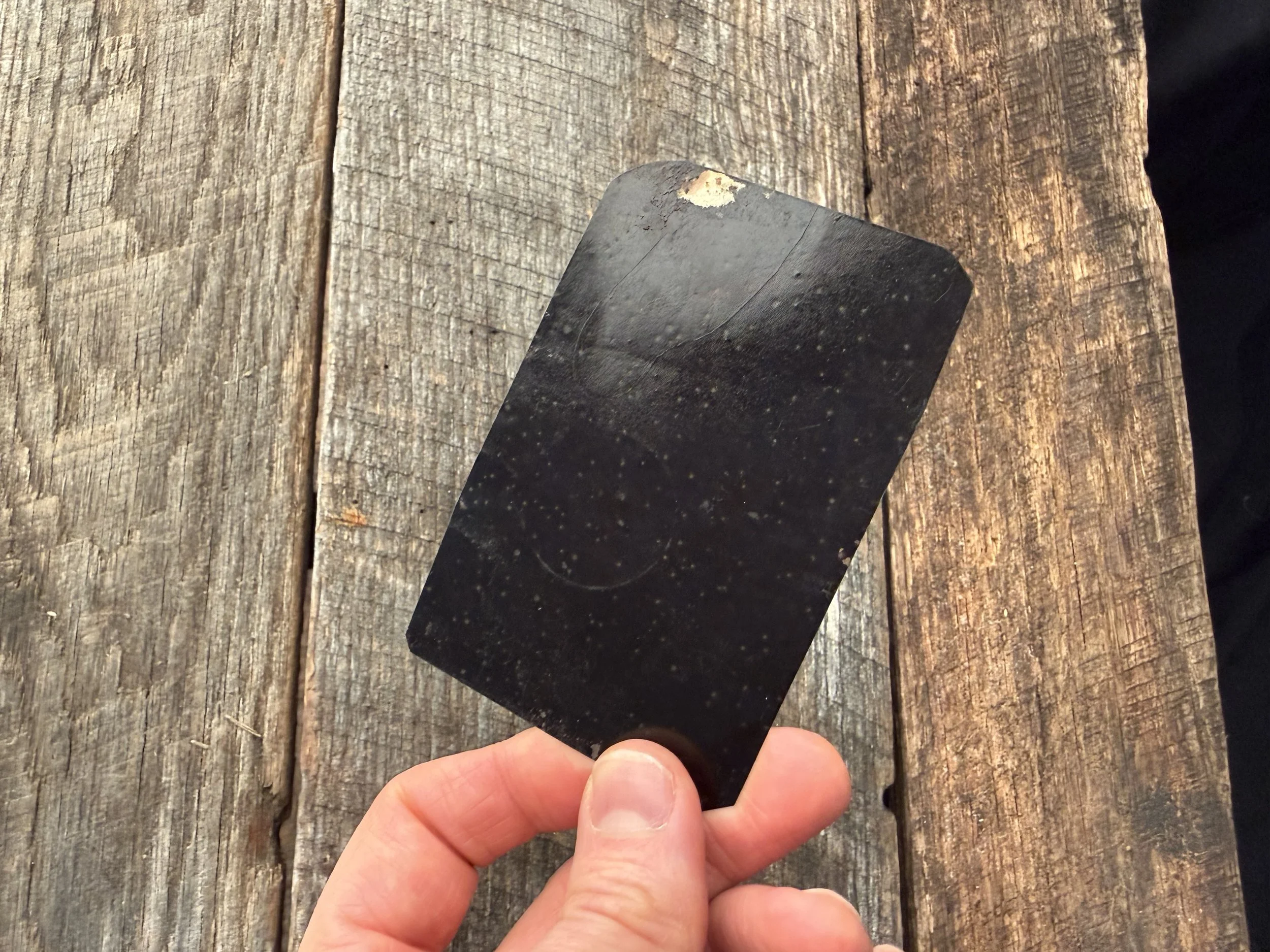
The tintype's heyday ran from the late 1850s through the 1880s, though the process continued in carnivals and boardwalk photo booths well into the 1900s. And of course, there's a community of us making them today.
How to identify a tintype
It's on a thin sheet of metal, either iron (historical) or aluminum (modern)
A magnet will stick to a historical tintype (iron) but not to a modern one (aluminum)
It's lightweight and slightly flexible. You could bend it if you tried, though please don't
The image does not shift or mirror like a daguerreotype
Often found loose, in paper sleeves, or in albums rather than in cases (though cased tintypes exist)
The edges may show the dark lacquer or coating on the metal
Side-by-side comparison
Here's how those three photographs from the top of this post actually break down.
| Daguerreotype | Ambrotype | Tintype | |
|---|---|---|---|
| Dates | 1839–1850s | 1854–1860s | 1856–1900s (and today) |
| Surface | Silver-plated copper | Ruby glass (or clear glass with dark backing) | Iron (historic) or aluminum (modern) |
| Image quality | Mirror-like, shifts with viewing angle | Soft, luminous, seen through glass | Direct, on the surface |
| Weight | Heavy | Medium | Light |
| Magnet test | No (copper) | No (glass) | Yes for historic iron, no for modern aluminum |
| Usually found in | Hinged case with brass mat | Hinged case with brass mat | Loose, in paper sleeves, albums, or occasionally cases |
| Fragility | Surface is delicate, needs glass cover | Glass can crack or shatter | Very durable, can bend |
| Chemistry | Silver-plated copper + mercury vapor | Wet plate collodion (Archer, 1851) | Wet plate collodion (Archer, 1851) |
| Still made today? | Rarely | Yes | Yes |
So which one are you looking at?
If you've found an old photograph in an attic, at an estate sale, or in a family collection, here's a quick way to work through it:
Is it in a case? Both daguerreotypes and ambrotypes typically came in hinged cases. Tintypes sometimes did too, but more often they were loose or in paper mats.
Does the image shift like a mirror when you tilt it? That's a daguerreotype. Nothing else does that.
Is it on glass? Hold it up carefully. If you can see light through the edges or if removing backing material turns the image into a negative, it's an ambrotype.
Does a magnet stick to it? If yes, you've got a historical tintype on iron. If no, and it's on metal (not glass, not mirror-like), it could be a tintype on aluminum, which means it's likely modern.
Is it lightweight, thin, and slightly flexible? That's a tintype.
And if you're browsing Facebook Marketplace and someone is selling a "daguerreotype" for $30? It's almost certainly a tintype. Daguerreotypes, when they come up for sale through reputable dealers, typically sell for quite a bit more, depending on the subject and condition.
About these processes today
I shoot tintypes and ambrotypes every month out of my studio in Franklin, Tennessee, just outside Nashville. The wet plate collodion process is the same one photographers used in the 1850s and 1860s. The cameras I use are from 1907 and the 1950s. The chemistry hasn't changed.
If you want to learn more about how the tintype process works, I wrote a detailed walkthrough here: What Is Tintype Photography? A Quick Guide to the Wet Plate Process. And if you're curious about getting your own portrait made, you can check out my pricing and scheduling page or reach out directly.
About Blake Wylie
Blake Wylie is a contemporary tintype photographer and wet plate collodion artist. He has been creating tintypes and ambrotypes with the wet plate collodion process since 2011. Based in Franklin, Tennessee, near Nashville, his work spans handmade portraiture, fine-art projects, musician collaborations, and commercial commissions on metal and glass. He writes about tintype and early photographic processes from firsthand studio and on-location experience. His work has been featured by PBS Tennessee Crossroads, PetaPixel, Fstoppers, and other outlets.